
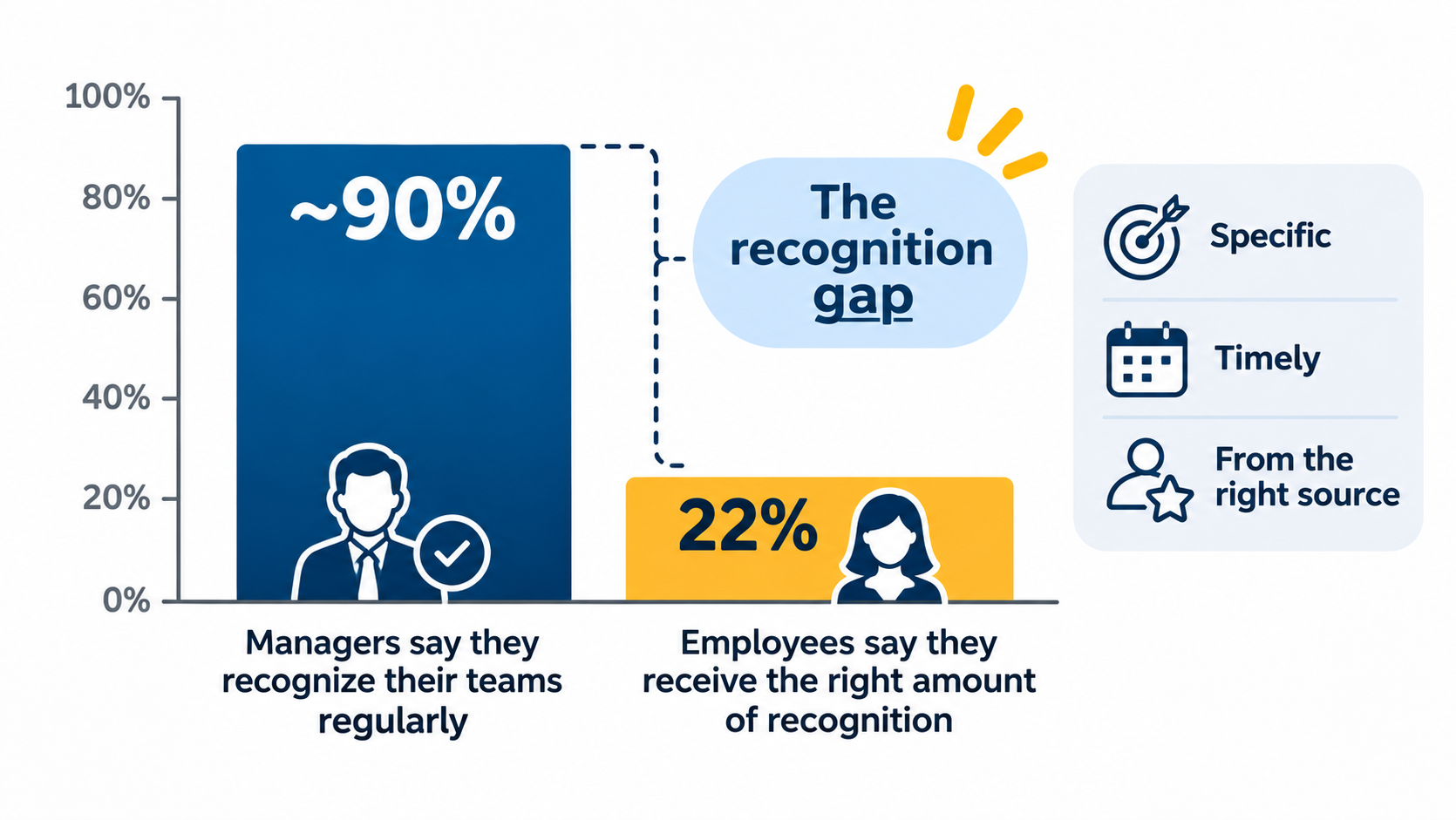
Ask any manager whether they regularly recognize their team, and almost all of them will say yes. Ask the employees on those same teams whether they feel regularly and meaningfully recognized, and their answers look nothing like the managers'.
This is the employee recognition gap, the distance between what a leader believes they are delivering and what the employee actually receives. It is not primarily a frequency problem. Most managers are sending some form of appreciation regularly. It is a quality problem. The difference between recognition employees register and recognition that disappears as noise is the difference between a manager who knows specifically what someone did and tells them why it mattered, and a manager who says "great job this week" on a Friday afternoon because the moment felt right.
Why Do Our Engagement Scores Show Employees Don't Feel Recognized When Our Managers Say They Recognize Their Teams Constantly?
Because the two groups are measuring different things. When a manager says, "I recognized my team this week," they usually measure effort: they sent a thank-you message, gave a shoutout in the team meeting, or posted appreciation on the platform. When an employee assesses whether they feel recognized, they are measuring something different: did someone with authority and knowledge of my work tell me specifically what I did, why it mattered, and that they saw it?
Those are not the same experience. A manager can send ten recognitions in a week and have none of them register at the threshold employees need for recognition to affect their engagement. The employee recognition gap isn't visible from the leader's side. It is entirely visible from the employee's.
Research from Gallup and Workhuman, tracking nearly 3,500 employees from 2022 to 2024, found that well-recognized employees were 45% less likely to turn over after two years. The same research identified that only 22% of employees say they currently receive the right amount of recognition for the work they do. The math is direct: most organizations are not closing the gap between what they believe they are delivering and what employees are actually experiencing, and the retention cost compounds year over year.
What Does High-Quality Recognition Look Like, and How Is It Different From What Most Organizations Deliver?
High-quality recognition has three dimensions that most organizational programs fail to build into the manager's actual behavior.
The first is specificity. Recognition that says "you've been doing great work" is not specific. Recognition that says "the way you handled the client escalation on Tuesday, and specifically the decision you made to escalate it before it became visible to leadership, showed exactly the kind of judgment this team needs" is specific. Specificity is what tells the employee that the person recognizing them was actually paying attention. Generic appreciation tells them the opposite.
The second is timing. Recognition delivered three weeks after a notable contribution does not connect the appreciation to the behavior in the employee's experience. The neurological response to genuine recognition is short-lived, which is why Gallup identifies the seven-day window as the threshold for recognition to influence engagement. A manager who waits for the quarterly review to acknowledge outstanding work has missed the window approximately twelve times.
The third is source. Manager recognition practices matter because the source of recognition determines its weight. Recognition from a peer is pleasant. Recognition from the manager who assigns the work, evaluates the performance, and holds the employee's career trajectory in their hands carries entirely different significance. A peer-to-peer recognition platform can drive high usage. It does not substitute for the manager who makes time to say something specific, directly, in a one-on-one.

Why Does Generic Recognition Sometimes Erode Trust Faster Than Silence?
Because it signals that the leader wasn't paying attention but tried to pretend that they were. A high performer who receives the same "great job" they have heard applied to every average contribution reaches a specific conclusion: either my manager cannot tell the difference between what I do and what anyone else does, or they can tell and don't think it's worth acknowledging specifically. Neither interpretation keeps a high performer engaged.
HBR research on high performers found that managers tend to focus their attention and specific feedback on underperformers, leaving high performers, who have the most options and the clearest sense of their own market value, to operate on a diet of generic appreciation that tells them nothing about whether their distinct contribution is visible. High performers do not seek constant validation. They seek proportional recognition that reflects the magnitude of what they actually built. When the recognition they receive is indistinguishable from what their lowest-performing peer received, the recognition-and-retention equation begins to shift.
What Do Organizations That Close the Recognition Gap Actually Do Differently?
They treat recognition as a manager capability, not a program feature. The organizations where employees report feeling genuinely recognized are not the ones with the most sophisticated platforms. They are the ones whose managers have been developed to build specific, timely, individual recognition into their daily and weekly rhythms as a non-negotiable leadership behavior.
This means managers know exactly what each person on their team is working on, what the stakes are, and what strong performance in that context looks like. It means they give recognition within the window where it connects to the behavior. And it means they know, for each person, how that individual prefers to receive recognition, because the delivery mode is part of what makes recognition effective for that specific person.
Closing the employee recognition gap is not a tool deployment. It is a leadership development priority. And the first step is acknowledging that the gap exists, not in the program's design, but in the daily behavior of the people running the team.
Leaders who are ready to build that capability directly will find the framework for it in the Designed to Care® Masterclass. Join the next session and leave with the specific tools for giving recognition that employees actually receive as recognition.
What Does a Recognition Culture Actually Look Like from the Employee's Side?
A recognition culture is not visible in the number of appreciations sent or the platform adoption rate. It shows up in whether employees can describe, specifically, the last time someone in the organization told them something specific about their work that they didn't already know. That is the test.
In organizations where manager recognition practices are strong, employees can answer that question immediately with a recent example from someone whose opinion they value. In organizations where programs substitute for systems, employees either cannot answer or reach back months to find an example. The difference in engagement, productivity, and retention between those two groups is not marginal. It is the difference between an organization people invest in and one they leave when the next recruiter calls.
The Designed to Care® philosophy is built on the understanding that the Employee Experience is shaped by the daily behavior of the person someone reports to, not by the tools that surround them. Join the next Designed to Care® Masterclass and build the recognition practices that make your leadership visible in the way that actually retains the people you need most.
For organizations ready to audit their full recognition infrastructure alongside leadership development, TalenTrust's Employee Experience Surveys and Talent & Community Scorecard offer a diagnostic starting point.
FAQ
Q: Our managers give regular team shoutouts in all-hands meetings. Is that enough?
Public recognition in a group setting has value, but it is one form of recognition, not a complete system. Team shoutouts reach everyone at once, which means the signal is diffused. The employee receiving the shoutout knows it was shared with fifteen other people simultaneously, which reduces its signal of specific, individual visibility. One-on-one recognition that names exactly what that person did and why it mattered carries more weight than a group acknowledgment, and should happen more often.
Q: How do we know what kind of recognition each person on our team actually wants?
Ask them directly, before the recognition opportunity rather than during it. "How do you prefer to receive appreciation when you've done strong work: publicly, privately, written, verbal?" is a question most managers have never asked, and most employees have never been asked. The answer shapes everything about how recognition lands. A manager who knows one person on their team dislikes public shoutouts and another is energized by them can show the same level of appreciation in ways that actually reach each person.
Q: Is it possible to over-recognize to the point where the recognition loses meaning?
Yes, when the recognition is generic. If a manager responds to every contribution with "great work," the phrase loses signal within weeks. The antidote is not less recognition; it is more specific recognition. A manager can recognize someone every day if each recognition is genuinely specific to something that person did. The frequency becomes a problem only when it outpaces specificity, creating noise instead of signal.