
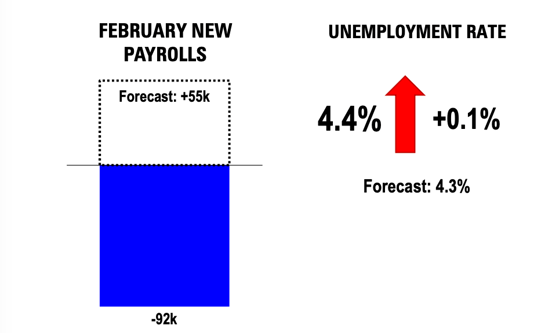
The U.S. economy lost 92,000 jobs in February, falling well short of forecasts that expected 55,000 new jobs. This marks one of the clearest signals so far this year that hiring conditions are becoming less predictable across multiple sectors.
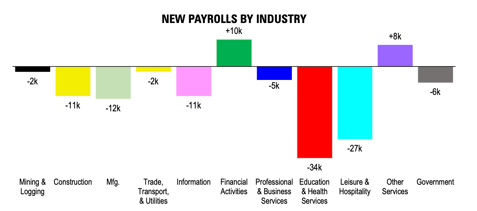
Private sector hiring accounted for most of the decline, with 86,000 jobs lost, and contraction appeared across nine of eleven major industries.
Key Insights:
Check out the recording of our LinkedIn Live with TalenTrust's Erin Dougan for an overview and interpretation of the February 2026 Jobs Report.
Broad-Based Job Losses Across Key Sectors
The largest decline came from Education and Health Services, which lost 34,000 jobs. This is the first contraction in that category in more than four years.
A major driver was a strike involving 31,000 Kaiser Permanente employees, which significantly impacted the monthly total.
Leisure and Hospitality followed closely behind, shedding 27,000 jobs, largely driven by a 30,000-job decline in restaurants and bars.
Other sectors also showed weakness:
- Construction declined, likely influenced by unusually harsh winter weather
- Trade, Transportation, and Utilities also softened under similar conditions
One of the few bright spots came from Financial Activities, which added 10,000 jobs, while Other Services gained 8,000 jobs, led mostly by repair and maintenance hiring.
Unemployment Ticks Higher
The unemployment rate rose unexpectedly from 4.3% to 4.4%.
At the same time, the labor force participation rate fell to 62.0%, the lowest level since 2021.
Part of that change reflects updated Census-based population estimates from the U.S. Bureau of Labor Statistics, which lowered the estimated number of prime-age men in the workforce.
That adjustment also revised January’s participation rate lower, from 62.5% to 62.1%.
Wage Growth Remains Firm
Despite weaker hiring, wage growth held up better than expected.
- Average hourly earnings rose 0.4% for the month
- Annual wage growth reached 3.8%, slightly above forecast
For nonsupervisory workers:
- Monthly earnings increased 0.3%
- Annual earnings rose 3.7%
This suggests that while hiring may be slowing, compensation pressure remains.
What This Means for Employers
February’s data reinforces an important message: labor market conditions are shifting, and employers should pay close attention to where pressure is building and where momentum is slowing. A softer market does not remove hiring challenges. It changes how and where they show up.
Ready to take your talent strategy to the next level? Contact us today.